Although we had lots of hints over the years, it wasn’t until April 3, 2006 that we conclusively proved that bullet shape makes a big difference and quantified it with numbers. For years we wanted to believe that if we could set the boomers off with a .22LR bullet going a particular velocity, then the boomers would detonate with any same-diameter-or-larger bullet going the same velocity. This isn’t true. We found this out in a very painful way during the Precision Rifle Clinic of Boomershoot 2005 — the same targets we could detonate with a .22LR from 15 yards away had multiple .30 caliber holes with bullets in excess of 2000 fps.
Research & Testing
We ran a series of tests in the fall of 2005 and spring of 2006 on an improved mix. The findings are documented in these blog posts:
Test Results
We measured the minimum velocity for successful detonation using these two bullets:
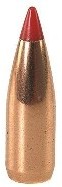
0.224” diameter 50 grain
Hornady V-MAX

American Eagle .22LR (AE22)
.22LR (flat point)
Reliably detonates the present mix (as of spring 2006) at 1,170 fps.
Hornady V-MAX (pointed tip)
Requires 1,700 fps to achieve 50% detonation probability. For equivalent probability to the .22LR, the difference is approximately 550 fps. At this velocity the V-MAX bullet does not expand in the Boomerite targets.
Why the Difference?
We believe the difference is due to the flat point of the .22LR versus the very pointed tip of the V-MAX. The flat point increases compression of the air spaces between particles of the explosive mix, resulting in more heating for the same velocity.
What This Means for Boomershooters
A bullet with a high ballistic coefficient will retain more velocity downrange, but may also have a shape that doesn’t detonate targets as easily. A bullet with a flat tip at a lower target velocity may give better detonation results.
However, if you are delivering a bullet at greater than 1,700 fps at the target, virtually any bullet shape is expected to detonate them.